
Short on time? This 10-minute warm-up Exercises before any workout gets your heart, joints, and muscles ready. No equipment needed. Here’s the exact routine.
10-Minute Warm-Up Exercises Before Any Workout
Let me guess. You’ve got 45 minutes for a workout, and the warm-up feels like the part you can skip. Walk in, grab the weights, go.
I get it. I’ve done it too. And I’ve also felt that tight, creaky first set where my hips said no and my shoulders said “absolutely not.”
A 10-minute warm-up before any workout fixes that. It’s not fancy, and it won’t make a good Instagram reel. But it’s the cheapest upgrade in fitness.
Why Warm Up for 10 Minutes Before Exercising?
Think of your body like a cold car on a winter morning. You can floor it right away. It just won’t love you for it.
A good warm-up does a few simple things:
- Raises your heart rate gradually, so you’re not shocking your system.
- Increases blood flow to the muscles you’re about to use.
- Improves joint mobility, so you move more freely.
- Wakes up key muscles, like your glutes and shoulders.
- Gets your brain in the game, because movement patterns feel smoother once you’ve rehearsed them.
Can a warm-up help prevent injury? It may reduce your risk, but it can’t erase it. Think of it as good prep, not a force field.
Is 10 Minutes Enough?
For most strength training, cardio, HIIT, and home workouts, yes. Ten minutes is the sweet spot: long enough to do the job, short enough that you’ll actually do it.
If you’re doing something very intense or competitive, like heavy max lifts or race-day efforts, you may want a longer, more specific warm-up. For everyday training, 10 minutes works.
For a detailed explanation, check our guide on 10-Min Morning Workout Routine for Beginners.
Dynamic vs. Static Stretching: Which One Before a Workout?
Quick answer: go dynamic.
Dynamic stretching means moving through a range of motion (leg swings, arm circles). Static stretching means holding a position for 30 seconds or more.
| Dynamic Stretching | Static Stretching | |
|---|---|---|
| What it is | Controlled movement | Holding a stretch |
| Best time | Before your workout | After your workout |
| Main goal | Prepare and activate | Relax and improve flexibility |
| Example | Leg swings | Seated hamstring hold |
Save the long holds for after you train or a separate flexibility session. Holding stretches as your only warm-up is a common mistake.
What Should a 10-Minute Warm-Up Include?
Every solid routine has four parts:
- Light aerobic movement to raise your heart rate
- Dynamic mobility to loosen your joints
- Muscle activation to wake up the big players
- Workout-specific rehearsal to practice what you’re about to do
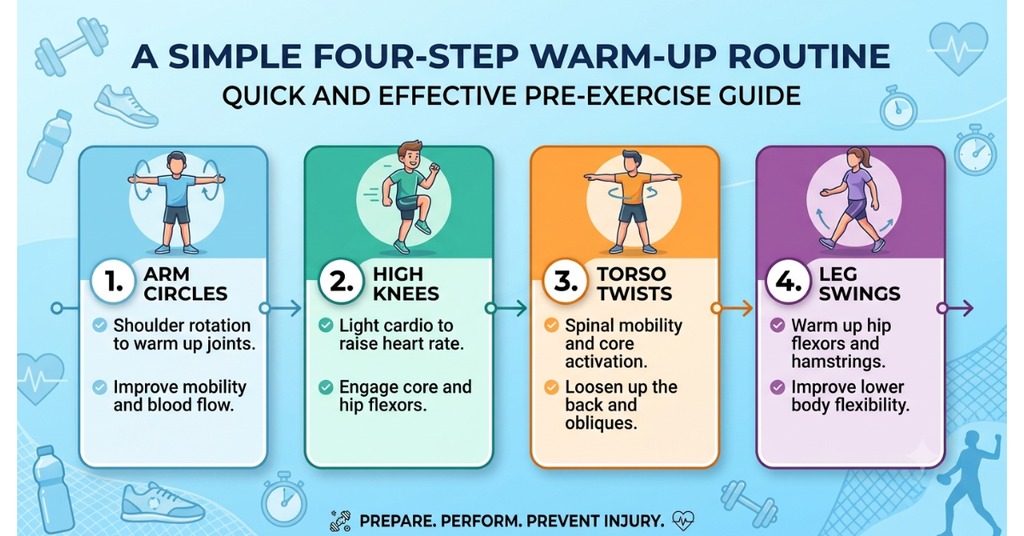
The Full-Body 10-Minute Dynamic Warm-Up Routine
No equipment. No excuses. Just a bit of floor space.
| Minutes | Phase | Exercise | How Much |
|---|---|---|---|
| 0:00–2:00 | Light cardio | Marching in place or easy jumping jacks | 2 minutes |
| 2:00–3:30 | Upper-body mobility | Arm circles (forward and back) | 10 each way |
| Plank shoulder taps | 10 per side | ||
| 3:30–5:30 | Lower-body mobility | Leg swings (front-to-back) | 10 per leg |
| Hip circles | 8 each direction | ||
| Walking lunges | 8 per leg | ||
| 5:30–7:30 | Activation | Bodyweight squats | 10–12 |
| Glute bridges | 12 | ||
| 7:30–9:00 | Movement prep | High knees | 30 seconds |
| Inchworms or easy burpee-style reps | 6 | ||
| 9:00–10:00 | Rehearsal | First exercise of your workout, light load | 6–10 reps |
A few quick tips so you get the most out of it:
- Move smoothly. You’re loosening up, not racing.
- Breathe. Sounds obvious. You’d be surprised.
- Stay below “tired.” If you’re out of breath by minute six, ease off.
That last rehearsal step is my favorite. Doing a few light reps of your first exercise is like a dress rehearsal. By the time the real set arrives, your body already knows the script.
Can I Do This at Home Without Equipment?
Yes. Everything above works in a hallway, a living room, or a hotel room. Jumping jacks, marching, squats, lunges, glute bridges, and plank shoulder taps need nothing but you.
If you want to make it a little nicer, a mat helps (more on that below).
Swap-Ins for Different Workouts
The routine above is a solid default. Here’s how to tweak it.
Before Leg Day
Focus on ankles, knees, hips, glutes, and hamstrings. Add hip circles, walking lunges, and glute bridges. Finish with a few light squats, with an empty bar or a band if you have one.
Before Running
Start with brisk walking or an easy jog. Then add leg swings, high knees, butt kicks, ankle circles, and walking lunges. Finish with a few short, relaxed accelerations.
Before HIIT
Keep the structure, but spend a bit more time on the cardio and high knees. HIIT asks a lot quickly, so you want your heart rate already up.
Before Walking or Low-Intensity Cardio
Yes, warm up here too. It can be shorter. Just start slower and gradually build speed or incline over several minutes.
Beginners vs. Advanced Lifters
| Beginners | Advanced | |
|---|---|---|
| Structure | Same four parts | Same four parts |
| Impact | Lower (marching instead of jumping) | Add jumps or drills |
| Reps | Fewer | More, plus ramp-up sets |
| Movements | Simple | Sport-specific |
Same idea, different dial settings.
Read our complete guide on Walking vs Running for Weight Loss.
Common Warm-Up Mistakes to Avoid
- Rushing. Ten minutes feels long until you’re the one skipping it.
- Skipping movement-specific prep. Warming up your whole body is great, but practice the pattern you’re about to lift or run.
- Making static stretching your only warm-up. Holds are for later.
- Going full intensity right away. Your first set shouldn’t be your hardest.
Optional Gear That Makes a Warm-Up Nicer
You don’t need anything. But a few inexpensive tools can make this routine more comfortable and more effective:
| Goal | What Helps | Examples |
|---|---|---|
| Floor comfort | Exercise mat | Gaiam Thick Yoga Mat, Amazon Basics 1/2-Inch Exercise Mat |
| Glute activation | Loop bands | Fit Simplify Resistance Loop Bands, fabric loop bands |
| Shoulder prep | Resistance bands | Theraband bands for pull-aparts |
| Pre-workout mobility | Foam roller | TriggerPoint GRID, Amazon Basics High-Density Roller |
| Stretching support | Strap or blocks | Gaiam Yoga Strap, ProsourceFit Yoga Blocks |
| Tight spots | Massage gun | Theragun Mini, Hypervolt Go 2 |
| Run warm-ups | GPS watch | Garmin Forerunner 55 |
Best starter kit: a non-slip mat, loop bands, and a basic foam roller. That covers most of what you need.
Check out our detailed article on How to Stay Consistent with Exercise.
Disclosure: some links on this page may be affiliate links, which means we may earn a small commission at no extra cost to you. Prices and availability change, so check the current listing.
Quick FAQ
What are the best 10-minute warm-up exercises?
Light cardio, arm circles, leg swings, hip openers, squats, lunges, glute bridges, and a few light reps of your first exercise.
Should I warm up before a casual walk?
Yes, just keep it short and start slow.
Can warming up prevent injury?
It may lower your risk by preparing your muscles, joints, and nervous system, but it can’t eliminate it.
The Bottom Line
A 10-minute warm-up isn’t glamorous. But it’s the difference between a workout that feels stiff and sluggish and one that feels smooth.
If you’re new to training, have an injury, or have a health condition, check with your doctor or a qualified trainer before starting. Otherwise, you can start today.
Your move: Try this routine before your next workout and see how your first set feels. Then tell me in the comments which move made the biggest difference. And if you know someone who skips their warm-up, send them this.
Author Bio:
Hi, I’m MACHHINDRA Jadhav — a passionate Health Content Writer with 4+ years of experience in the health and wellness space. I specialize in breaking down complex topics like Disease & Conditions, Fitness, Mental Health, and Nutrition into simple, practical advice you can actually use in your daily life.
My goal is not just to inform, but to empower you to take control of your health naturally and confidently. Every article I write is backed by research, real insights, and a deep commitment to helping people live healthier, stronger, and more balanced lives.
If you’re looking for clear, honest, and actionable health guidance — you’re in the right place.
Disclaimer:
This content is for informational purposes only and is not intended as medical advice. Individual results may vary. Please consult a qualified healthcare professional or nutritionist before making any significant changes to your diet or weight loss plan.