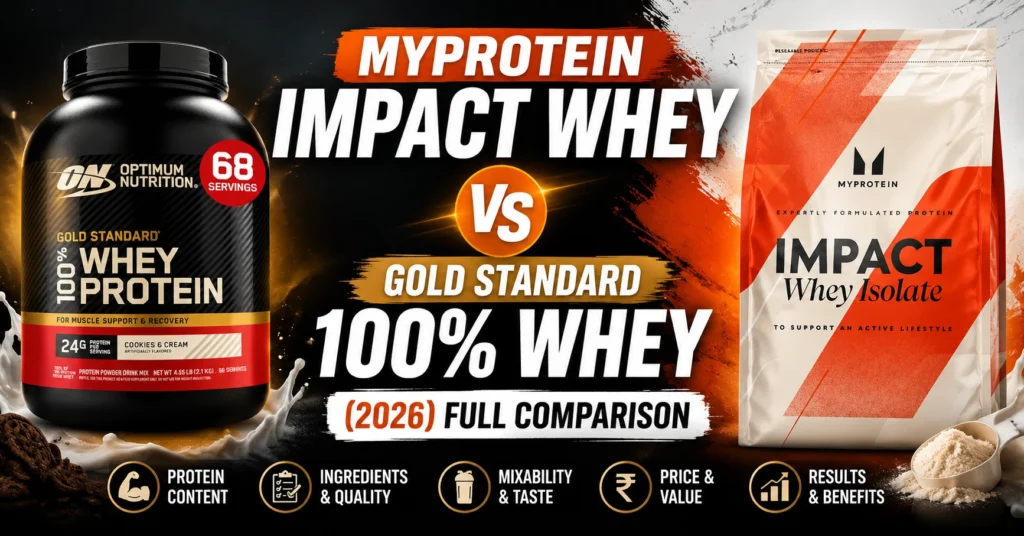
MyProtein Impact Whey vs Gold Standard Whey: Compare ingredients, protein, taste, price, benefits, and value to find the best whey protein in 2026.
MyProtein Impact Whey vs Gold Standard 100% Whey (2026) Full Comparison
Two tubs dominate almost every “best whey protein” search result, every gym-bag shelf, and every r/Supplements thread: Optimum Nutrition’s Gold Standard 100% Whey and MyProtein’s Impact Whey Protein. Between them, these two brands have sold more scoops of whey than the rest of the category combined, and for good reason — both are third-party tested, both have decades of track record, and both show up reliably in independent lab testing.
That popularity is exactly what makes choosing between them harder, not easier. The label copy on both tubs promises “premium protein” and “muscle support,” but the actual formulas, the digestion experience, the true cost per gram, and the flavor lineups are meaningfully different. This guide breaks down every variable that should factor into your decision — not just the marketing claims — so you can match the right tub to your actual goal, budget, and stomach.
The Quick Verdict
The key points you need to know are right here.
Choose Optimum Nutrition Gold Standard 100% Whey if you want an isolate-forward formula, the lowest lactose load of the two, the most consistent mixability in a shaker bottle, and near-universal retail availability in the United States.
Choose MyProtein Impact Whey Protein if your priority is the lowest realistic cost per gram of protein, the largest flavor catalog in the category, and you don’t mind a slightly heavier concentrate-based texture.
Neither product is objectively “better” in a vacuum — they’re built for different priorities. A tested powerlifter cutting weight and a college student bulking on a budget will reasonably land on different tubs, and both would be making the right call for themselves.
Thinking about choosing MyProtein Impact Whey?
Check the latest price, available flavors, serving sizes, and current offers before you buy.
👉 Check MyProtein Impact Whey Price & Offers

- FLAVORED AWESOMENESS: We know, plain protein can be a yawn. That’s why our Impact Whey Protein comes in delicious flavor…
- HIGH-PROTEIN POWDER: Loaded with an impressive 22g of whey protein concentrate per serving. This powerful muscle builder…
- BLEND OF WHEY: To reach your fitness objectives, our whey protein powder is designed with premium nutrients. This produc…
What Whey Protein Concentrate vs. Isolate Actually Means
Before comparing labels, it helps to understand what separates these two products at a manufacturing level, because that difference explains almost every other row in this comparison.
Whey protein starts as a liquid byproduct of cheese-making. From there, manufacturers filter it to different degrees:
- Whey protein concentrate (WPC) is the least-processed form, typically 70–80% protein by weight, with the remainder made up of lactose, fat, and other milk-derived compounds. It’s the most affordable form to produce and the one used in most muscle-protein-synthesis research over the last three decades.
- Whey protein isolate (WPI) goes through additional microfiltration or ion-exchange processing to strip out most of the lactose and fat, landing around 90% protein by weight. It costs more to manufacture and typically carries a higher shelf price.
- Whey protein hydrolysate (WPH) is partially pre-digested through enzymatic hydrolysis, breaking long protein chains into shorter peptides that absorb faster. It’s the most processed and most expensive of the three.
MyProtein’s Impact Whey is a straight whey concentrate. Optimum Nutrition’s Gold Standard lists whey isolate first on the label, followed by concentrate and a small amount of hydrolysate — an isolate-forward blend, not a pure isolate. That single manufacturing decision is the root cause of nearly every difference covered below: protein density, lactose content, price, and even mixability trace back to how each powder is filtered.
Nutrition Facts Compared
Here’s how the two stack up on paper, per standard scoop:
| Spec (per scoop) | Gold Standard 100% Whey | Impact Whey Protein |
|---|---|---|
| Serving size | 30–32 g (flavor-dependent) | 25 g |
| Calories | ~120 | ~100–103 |
| Protein | 24 g | 18–22 g (flavor-dependent) |
| Carbohydrates | 3 g | 1–3 g |
| Sugar | 1–2 g | 1 g |
| Fat | 1–1.5 g | 1.5–1.9 g |
| Naturally occurring BCAAs | ~5.5 g | ~4.5 g |
| Primary sweetener | Sucralose, acesulfame potassium | Sucralose |
| Emulsifier | Soy lecithin | Soy lecithin |
Here are some noteworthy points that aren’t obvious from the spec sheet alone:
Protein per scoop favors Gold Standard, but protein per dollar tells a different story (more on that below). The isolate-forward blend pushes Gold Standard’s protein density to roughly 75–80% of the scoop’s total weight, while Impact Whey’s concentrate-only formula lands closer to 80–88% protein depending on flavor — the flavor variance on Impact Whey is larger than most buyers expect, so it’s worth reading the specific SKU’s label before assuming 22 g across the board.
Carbohydrate and lactose content run lower on Gold Standard, a direct consequence of the isolate-forward blend removing more of the milk sugar during filtration. This matters far more to lactose-sensitive buyers than to anyone counting carbs for general fitness purposes — the actual gram difference (1–2 g of carbs) is nutritionally trivial for most people.
Both rely on artificial sweeteners. If you specifically avoid sucralose or acesulfame potassium, neither of these two products fits your criteria — you’d need to look at a stevia- or monk-fruit-sweetened alternative instead.
Check out our detailed article on Gold Standard Whey Review 2026.
Ingredient Quality and Label Transparency
Gold Standard’s ingredient list opens with whey protein isolate, followed by whey protein concentrate, then hydrolyzed whey protein isolate, plus a small digestive-enzyme blend (typically including Aminogen and lactase) intended to improve protein breakdown and reduce bloating. This layered approach is the formulation strategy that has kept Gold Standard at the top of the category for roughly two decades — it isn’t a pure isolate product, but it borrows enough isolate and hydrolysate to price and market itself close to one.
Impact Whey’s label is far simpler: whey protein concentrate (listed around 96–98% of the formula), soy lecithin as an emulsifier, flavoring, sweetener, and a coloring agent in chocolate-based SKUs. There’s no isolate, no hydrolysate, and no added enzyme blend. That’s not automatically a downgrade — concentrate is the form of whey used in the majority of the sports-nutrition literature on muscle protein synthesis, and it remains the most cost-efficient, well-studied form of whey protein on the market. According to a nutrition-focused comparison from Transparent Labs, both isolate and concentrate are highly bioavailable protein sources that support comparable strength and recovery outcomes, with isolate’s main advantage being easier digestion rather than superior muscle-building potential.
The practical takeaway: Gold Standard’s label reflects a more processed, more expensive raw material, and its enzyme blend is a genuine (if modest) added-value feature. Impact Whey’s label reflects a simpler, cheaper, well-established raw material with nothing extra layered on top. Neither is dishonest — Optimum Nutrition markets the processing premium, and MyProtein markets the price advantage of skipping it.
What the Research Says About Muscle Growth

This is the section most comparison articles skip, and it’s the one that actually resolves the “which one builds more muscle” question buyers keep asking.
The short answer, backed by sports-nutrition research, is: neither has a meaningful advantage for muscle growth over the other. A review published by mindbodygreen covering a 2020 study in the Journal of Sports Medicine and Physical Fitness found that whey isolate and whey concentrate produced comparable improvements in strength, cardiorespiratory fitness, and overall training adaptations when protein intake and dosing were matched. In other words, once you control for how much protein you’re actually consuming, the processing level of that whey stops being the deciding factor.
The ISSN’s evidence-based guidance on protein and exercise, published in the Journal of the International Society of Sports Nutrition, reinforces the same point at a broader level: what predicts muscle protein synthesis and strength outcomes is total daily protein intake (the ISSN recommends 1.4–2.0 g per kilogram of body weight per day for most active individuals), the leucine content of the dose, and consistent distribution across the day — not which brand or filtration method produced the powder. A single serving of either Gold Standard or Impact Whey easily clears the ISSN’s recommended 20–40 g effective dose per serving, with 700–3,000 mg of leucine content per meal cited as the target range for maximizing the anabolic response.
Practically, this means the “better formula” argument in favor of Gold Standard is real but overstated when it comes to actual muscle-building outcomes. Isolate’s genuine advantages are faster digestion and lower lactose content — not superior hypertrophy.
Cost Per Gram of Protein: The Real Math
Sticker price per tub is the number brands want you to compare. Cost per gram of protein is the number that should actually drive your decision, because it’s the only metric that lets you compare two differently sized tubs with different protein densities on equal footing.
The formula is simple: (tub price) ÷ (servings per tub × protein per serving) = cost per gram of protein.
Running that math using standard direct-from-brand pricing:
- Gold Standard, 5 lb tub: roughly 74 servings at 24 g of protein each, for approximately 1,776 g of total protein. At a typical direct price in the $70s, that lands around $0.042–$0.045 per gram of protein.
- Impact Whey, 5.5 lb tub: roughly 99 servings at an average of ~20–21 g of protein each, for approximately 2,000–2,079 g of total protein. At sale pricing (which MyProtein runs frequently — often 35–55% off site-wide), that lands around $0.028–$0.032 per gram of protein.
At sale pricing, Impact Whey typically comes in 25–35% cheaper per gram of protein than Gold Standard. That gap narrows considerably if you catch Gold Standard on a Costco multi-pack or a deep Amazon discount, and it widens if you buy Impact Whey at full list price instead of waiting for a sale — which is a common first-time-buyer mistake, since MyProtein’s regular price is rarely what long-term customers actually pay.
For a lifter working through roughly one 5 lb tub per month, that per-gram gap typically translates to $15–$25 in monthly savings, or somewhere in the neighborhood of $200–$300 per year, favoring Impact Whey at sale pricing. That’s not a life-changing sum on its own, but stacked against the rest of a supplement budget — creatine, a pre-workout, electrolytes — it’s a meaningful line item over a training year.
Don’t miss our comprehensive guide on Cordyceps militaris Review.
Mixability, Taste, and Flavor Range
Gold Standard mixes noticeably faster in water. The isolate-forward blend disperses with less clumping and less foam, and most users report a smooth shake within 20–30 seconds using a standard shaker ball. This is consistently the most-repeated praise in long-form product reviews and independent hands-on coverage, including testing from Garage Gym Reviews, which notes that isolate-based powders generally mix more cleanly than concentrate due to their lower fat and lactose content.
Impact Whey mixes slightly slower and thicker, especially in water. As a pure concentrate, it takes a few extra seconds of shaking to fully dissolve, and a thin layer of foam is more common. In milk, oats, or yogurt, that textural gap essentially disappears — most people describe Impact Whey blended into milk as indistinguishable from Gold Standard in mouthfeel.
Flavor selection is where Impact Whey pulls decisively ahead. MyProtein maintains a rotating catalog of 40-plus Impact Whey flavors, including several no major competitor offers — Salted Caramel, Cinnamon Roll, Blueberry Cheesecake, and seasonal limited releases. Gold Standard’s lineup is smaller (around 20 flavors) but reliably consistent across batches, with fewer surprises and fewer discontinued options. If chocolate-and-vanilla fatigue is a real barrier to actually drinking your protein consistently, Impact Whey’s variety is a legitimate factor — not just a marketing gimmick, since adherence is what actually determines whether a supplement helps you hit your daily protein target.
Both brands publish full nutrition panels by flavor. It’s worth checking the specific flavor you’re buying rather than assuming the headline protein number applies across the board, particularly with Impact Whey, where protein-per-scoop can swing by several grams depending on added cocoa, caramel, or cookie inclusions.
Digestion, Lactose, and Gut Comfort
This is an underrated deciding factor that most comparisons treat as an afterthought.
Because Gold Standard’s blend leads with isolate, it carries meaningfully less residual lactose than a pure concentrate. For most lifters without lactose sensitivity, this distinction is irrelevant. For anyone who experiences bloating, gas, or mild GI discomfort from dairy, though, it’s a genuinely useful difference — the added digestive-enzyme blend (Aminogen and lactase) in Gold Standard is specifically designed to reduce that response further.
Impact Whey, as a straight concentrate, carries a higher lactose load per scoop. Most people tolerate it without issue, and concentrate remains the most widely consumed form of whey worldwide, but individuals with any degree of lactose intolerance are statistically more likely to notice digestive discomfort with a concentrate-only formula than an isolate-forward one.
Neither company markets this distinction loudly, but it’s arguably a more consistently reported difference between the two products than mixability or taste — and one worth weighing seriously if you already know dairy is a sensitive area for your stomach. If lactose sensitivity is a known issue rather than a maybe, a true isolate product (rather than either of these two blends) is usually the more reliable fix.
Third-Party Testing and Safety
Most SKUs from both brands carry Informed Sport or Informed Choice batch certification, an independent testing standard that screens finished products against the World Anti-Doping Agency’s list of banned substances. This matters most directly to competitive or tested athletes, but it’s also a reasonable baseline quality signal for anyone who wants assurance that a tub isn’t contaminated with unlisted ingredients or heavy metals above trace levels.
Coverage isn’t universal across every flavor and every production run, so if you compete in a tested federation, don’t assume certification carries over automatically — confirm the specific flavor and batch number against the current certificate published on the brand’s website before your next competition cycle.
How Much Protein Do You Actually Need?
Neither product matters much if your total daily protein intake isn’t dialed in first — the powder is a tool for hitting a target, not the target itself.
Per the ISSN’s position stand referenced earlier, most physically active adults do well in the 1.4–2.0 g of protein per kilogram of body weight per day range, with the higher end of that range more appropriate during a calorie deficit or an intense hypertrophy phase, where preserving lean mass is harder. Research summarized by the ISSN also suggests intakes as high as 2.3–3.1 g/kg during hypocaloric (“cutting”) periods for resistance-trained individuals may better protect muscle mass than the standard range.
For a 175 lb (79 kg) lifter, that works out to roughly 110–160 g of protein per day at the standard range, with a single 24 g or 20 g scoop covering somewhere between 15–20% of that target — meaning whole-food protein sources still need to carry most of the daily load. Whey protein is best treated as a convenient way to close gaps around training sessions or busy days, not a replacement for protein-rich meals.
Who Should Buy Which
Choose Gold Standard 100% Whey if you want:
- A more processed, isolate-forward formula with lower lactose and added digestive enzymes
- The fastest, most consistent mixability of the two
- A safer bet if you have a lactose-sensitive stomach
- Wide, dependable retail availability across major U.S. retailers
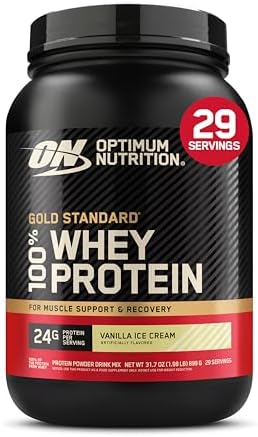
- 24 g High-Quality Whey Protein per Scoop – 100% of the protein from whey for a fast-absorbing, complete protein source t…
- 5.5 g Naturally-Occurring BCAAs + 11g of naturally occurring EAAs – Delivers essential amino acids including leucine, is…
- Low Sugar, Low Carb, Low Fat — Ideal for Lean Muscle or Cutting Phases – With just ~1 g sugar, ~3 g carbs per serving, a…
Choose Impact Whey Protein if you want:
- The lowest realistic cost per gram of protein in the category, especially at sale pricing
- The widest flavor catalog of any major whey brand
- A simple, no-frills concentrate label
- Better economics for high-volume users going through multiple tubs per month
Consider a different product entirely if:
- You need a near-zero-carb, near-zero-fat isolate for a strict cutting phase — a dedicated 100% isolate product from either brand fits better than either of these two blended formulas.
- You’re meaningfully lactose intolerant, not just mildly sensitive — a hydrolyzed isolate will typically sit easier than either product covered here.
- You want to avoid artificial sweeteners entirely — both of these rely on sucralose, so a stevia- or monk-fruit-sweetened whey is the better fit.
Continue reading our expert guide on Lost SuperFoods Book Review.
A Buying Checklist for Any Whey Protein
Use this checklist for any whey purchase, not just these two:
- Calculate cost per gram of protein, not cost per tub. Divide the price by (servings × protein per serving) to compare fairly across brands and sizes.
- Check the first ingredient on the label. “Whey protein isolate” listed first indicates a more filtered, generally more expensive formula than “whey protein concentrate” listed first.
- Confirm third-party testing if you compete in any tested sport — look specifically for Informed Sport, Informed Choice, or NSF Certified for Sport.
- Match the sweetener to your tolerance. Sucralose and acesulfame potassium are the most common; stevia and monk fruit are the go-to alternatives for anyone avoiding artificial sweeteners.
- Buy a small tub first. Both brands sell 1–2 lb starter sizes — testing a flavor for $15–$25 is far cheaper than discovering you dislike a flavor after committing to a 5 lb tub.
Frequently Asked Questions
Is Gold Standard actually better than Impact Whey, or just more famous?
Gold Standard has a more processed, isolate-forward formula with lower lactose and added digestive enzymes, which are genuine (if modest) advantages. For muscle-building outcomes specifically, research shows isolate and concentrate perform comparably when total protein intake is matched — so “better” mostly comes down to digestion comfort, mixability preference, and budget rather than raw muscle-building superiority.
Can I mix Impact Whey and Gold Standard in the same shaker?
Yes. Nothing in either formula is chemically incompatible, and combining flavors from each brand is a common way to extend variety without buying a third tub.
Is whey concentrate worse than whey isolate for building muscle?
No. When protein intake and total dose are equated, research consistently shows comparable strength and muscle-protein-synthesis outcomes between the two forms. Isolate’s real advantages are faster digestion, lower lactose, and lower fat — not superior gains.
Which one is easier on digestion?
Gold Standard, generally, because its isolate-forward blend carries less lactose and includes added digestive enzymes. Anyone with confirmed lactose intolerance should still consider a full isolate product over either blend.
How much whey protein should I actually drink per day?
That depends on your total daily protein target, not a fixed number of scoops. Most active adults should aim for roughly 1.4–2.0 g of protein per kilogram of body weight daily from all sources combined, using whey to fill gaps around training rather than as the primary protein source.
Where can I find the best price on each?
Impact Whey is almost always cheapest during MyProtein’s frequent site-wide sales — buying at full list price is generally not worth it when discounts run so regularly. Gold Standard is more reliably priced through major retailers, with bulk multi-packs typically offering the best per-pound value.
Final Verdict
This comparison doesn’t resolve into one “winner” because the two products are optimized for different priorities, not different quality tiers.
If your priority is formula sophistication, digestion comfort, and mixability, Gold Standard’s isolate-forward blend and added enzymes justify its higher price for buyers who value those specifics. If your priority is cost per gram of protein and flavor variety, Impact Whey remains the more efficient choice, particularly for high-volume users who go through multiple tubs a month.
Both are made by established, third-party-tested brands with long track records, and the underlying science shows neither has a meaningful muscle-building edge over the other once total protein intake is accounted for. The right choice comes down to your budget, your stomach, and how many flavors you need to stay consistent — not which tub has the shinier label.
Ready to Choose Your Whey?
After comparing protein content, ingredients, taste, mixability, price, and overall value, the right choice ultimately depends on your personal goals and budget.
Want to see today’s prices before deciding?

- FLAVORED AWESOMENESS: We know, plain protein can be a yawn. That’s why our Impact Whey Protein comes in delicious flavor…
- HIGH-PROTEIN POWDER: Loaded with an impressive 22g of whey protein concentrate per serving. This powerful muscle builder…
- BLEND OF WHEY: To reach your fitness objectives, our whey protein powder is designed with premium nutrients. This produc…

- 24 g High-Quality Whey Protein per Scoop – 100% of the protein from whey for a fast-absorbing, complete protein source t…
- 5.5 g Naturally-Occurring BCAAs + 11g of naturally occurring EAAs – Delivers essential amino acids including leucine, is…
- Low Sugar, Low Carb, Low Fat — Ideal for Lean Muscle or Cutting Phases – With just ~1 g sugar, ~3 g carbs per serving, a…
Compare the latest offers and choose the whey that fits your goals and budget best.
Sources
- International Society of Sports Nutrition Position Stand: Protein and Exercise — Journal of the International Society of Sports Nutrition
- Whey Protein Isolate vs. Concentrate — mindbodygreen
- Whey Protein: Concentrate vs. Isolate — Transparent Labs
- Whey Protein Isolate vs. Concentrate — Garage Gym Reviews
Affiliate Disclosure
Transparency matters: This article contains affiliate links to products such as MyProtein Impact Whey and Gold Standard 100% Whey. If you purchase a product through one of these links, I may earn a small commission at no additional cost to you.
My goal is to provide an honest and useful comparison based on factors such as protein content, ingredients, taste, mixability, price, value, and overall suitability. Affiliate relationships do not influence my comparison or recommendations. Product prices, availability, flavors, and promotions can change, so I recommend checking the retailer’s current information before making a purchase.
Thank you for supporting AI Blogging & Online Income through these affiliate links. Your support helps me continue creating helpful, research-based content and product comparisons.
Author Bio:
Hi, I’m MACHHINDRA Jadhav — a passionate Health Content Writer with 4+ years of experience in the health and wellness space. I specialize in breaking down complex topics like Disease & Conditions, Fitness, Mental Health, and Nutrition into simple, practical advice you can actually use in your daily life.
My goal is not just to inform, but to empower you to take control of your health naturally and confidently. Every article I write is backed by research, real insights, and a deep commitment to helping people live healthier, stronger, and more balanced lives.
If you’re looking for clear, honest, and actionable health guidance — you’re in the right place.